
Listening Beyond Words: What Children and Young People with Selective Mutism Want Schools to Understand
Oct 27, 2026
Back in 2021, we were delighted to support Rachel Wade, then a Trainee Educational Psychologist, by sharing her research project exploring the views of children and young people with selective mutism.
We are pleased to welcome Dr Rachel Wade back to share her findings, and to hear how she is now developing the research into resources for schools, families and professionals.
As a quiet child at school, and now an advocate for pupil voice, I have long been drawn to understanding children who appear quiet or find it difficult to use their voice in the classroom. This sparked my interest in selective mutism (SM), an anxiety-related condition in which a person can speak in some situations but finds speech difficult or impossible in others, often at school. It is not a choice. Some people prefer the term “situational mutism”, placing the focus on the situation rather than suggesting that the child is choosing not to speak.
SM is estimated to affect around 1 in 140 young children (NHS, 2023), although this may be an underestimate: some children may experience “hidden SM”, with their needs mistaken for shyness and left unidentified or unsupported (Kopp and Gillberg, 1997). Support can also vary considerably, leaving some children at risk of falling through the net (I CAN and Royal College of Speech and Language Therapists, 2018; SMiRA, 2018). Learning about these challenges prompted me to reflect on how well-placed educational psychologists are to help schools understand and support children and young people with SM, particularly as school is often where the anxiety underpinning SM becomes most apparent.
As I delved deeper into the research, I was struck by how often SM was explored from an outsider’s perspective, based on what others observed, rather than through the experiences of those I see as the experts: children and young people with SM themselves. Relying on outside observations can offer only a partial picture (Walker and Tobbell, 2015). This led me to ask: what makes a school feel safe, inclusive and manageable for a child or young person with selective mutism? That question became the heart of my research.
Creating a different way to listen
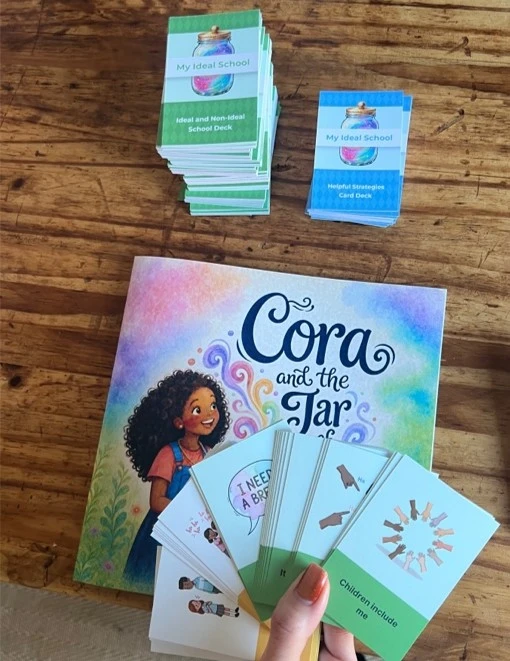
My research (Wade, 2022) involved ten children and young people aged 7–17 who were identified as having SM and attended mainstream schools in England. Nine had received a diagnosis of SM from another professional, such as a speech and language therapist, psychiatrist or psychologist, and one was awaiting diagnosis. Because a conventional spoken interview could itself create a barrier, I adapted the “Drawing the Ideal School” technique developed by Williams and Hanke (2007). Their approach was itself adapted from “Drawing the Ideal Self” (Moran, 2001), which invites a young person to explore a non-ideal self, an ideal self and the changes or support that might help them move towards their preferred future. Both techniques are informed by George Kelly’s Personal Construct Psychology (Kelly, 1955), which emphasises understanding how each person makes sense of themselves and their world. I reshaped these ideas into a flexible, online and non-verbal activity. Participants could sort visual prompt cards, draw, write, gesture, communicate through a parent or speak if and when they wished. The cards were informed by existing literature on the educational experiences and views of children with SM. This grounded the prompts in evidence rather than solely in my own assumptions. The participants explored three areas: a non-ideal school, an ideal school and changes that might move their current school closer to that ideal.
The method was deliberately creative, flexible and low pressure. It did not assume that speech was the best or only route to a meaningful contribution. Across several sessions, participants used combinations of cards, drawings, writing and speech. Their responses showed that children and young people with SM can communicate nuanced, thoughtful views when adults offer accessible ways for them to do so.
What did children and young people say?
Thematic analysis identified two broad sets of influences on participants’ school experiences. The first concerned influences outside the child (external factors): the physical environment, routines, staff and peers. The second concerned internal experiences, including fears, speaking identity, confidence and personal strengths. Participants’ accounts showed how these influences interacted. A teacher’s question, a crowded corridor or a change of routine could feel manageable for one pupil but highly exposing for another, depending on the relationships, context and expectations surrounding it.
Space, sound and predictability matter
“Most of the time I'm kind of like just waiting to get picked so it's like I start panicking and then I don't focus on the lesson as much as I probably should.” — Tris
Predictability mattered: anticipating being picked to speak could increase anxiety and make it harder to concentrate, as Tris’s account illustrates. Participants also described how large, crowded or confusing schools could feel overwhelming. They valued physical space, smaller groups, familiar routes and places where they could step back or regulate. Noise was important too. Very loud environments could interfere with attention and emotional regulation, but complete silence was not always comfortable either. The preferred environment was often quiet, but not silent; structured, but not rigid; familiar, but still offering choice.
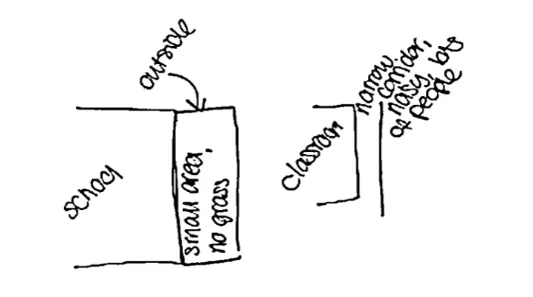 Hannah’s non-ideal school: narrow corridors and a small outside area.
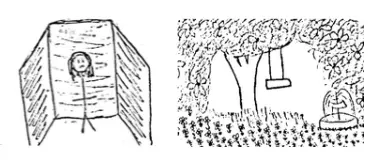 Isabelle’s drawings: enclosed space in her non-ideal school, contrasted with personal space in her ideal school.
The drawings made this contrast clear. Hannah depicted narrow corridors and a small outside area in her non-ideal school. Isabelle described a compact canteen and drew herself enclosed in a corner; her ideal classroom instead offered individual spaces and a choice of company or time alone. Across accounts, feeling “squashed”, “trapped” or “suffocating” contrasted with room to move and step back. As Tris explained, “But like outside there’s more air.” Space mattered physically and as a break from social demands.
Inclusion is not the same as pressure
“I shouldn't have to say that I'm struggling with speaking.” — Tris
A central tension ran through participants’ accounts. They did not want to be forced to speak, but they did not want to be ignored, excluded or permanently positioned as “the silent child”. They described helpful inclusion as being acknowledged and invited to participate without being put on the spot. Whole-class options such as writing, whiteboards or response cards could reduce exposure, while keeping opportunities to contribute open, without making speaking a requirement. The aim was not to remove every speaking opportunity, but to create safe routes into participation.
Relationships can reduce or increase pressure
“I think it definitely is the teachers, um I don't think it matters what the subject is whether I like it or not because if it's a subject that I like with a not very nice teacher it still wouldn't be very good.” —Isabelle
Participants’ accounts highlighted the powerful influence of staff and peers on whether school felt safe. They described how calm, patient, approachable adults who understood SM could make lessons and transitions more manageable. Trusted friends helped participants navigate school, communicate, join activities and feel that they belonged. All participants valued friends in their ideal school. Their accounts highlighted a wish for connection and belonging, with opportunities to join in without speech being a condition of participation.
Coco’s ideal-school drawing of children holding hands captured the importance of friendship: he explained that they were friends.
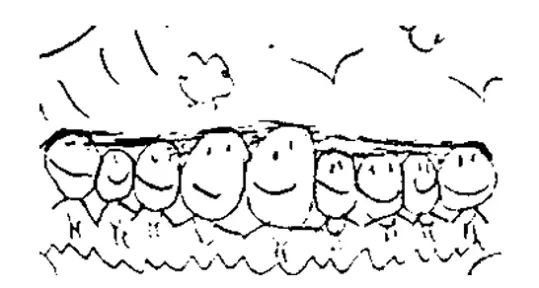 Coco’s ideal-school drawing: children holding hands, representing friendship and belonging.
By contrast, shouting, punishment, unpredictability, random questioning or well-intentioned encouragement that became pressure could intensify anxiety. Sometimes being overlooked brought immediate relief because no response was required, but that relief could sit alongside a painful sense of exclusion as captured in Tris’ account:
“I was kind of happy that she didn’t speak to me ‘cos that means I didn’t have to speak back, but at the same time I feel like she didn’t include me.” — Tris
There is no single “right” adjustment
“quiet, but not too quiet” — Olive
“not too big and not too small” — Hannah
Each participant described a different combination of needs and preferences. This led me to the “Goldilocks principle”: support should be collaboratively shaped until it feels “just right” for that individual child. One pupil may want a trusted adult nearby; another may experience this as intrusive. One may find communication cards liberating; another may feel that they reinforce an identity of not being able to speak. The important question is not, “What works for children with SM?” but, “What works for this child, in this setting, at this time?”
What can schools take from this?
Participants’ accounts suggest that participation does not have to mean speech. They valued whole-class ways to contribute, such as writing, whiteboards or response cards, which kept opportunities open without putting them on the spot.
Several described how random questioning, shouting, unpredictability or encouragement that tipped into pressure increased their anxiety. Being overlooked could bring relief, but often alongside a painful sense of exclusion.
The environment mattered too. Participants preferred spaces that were quiet but not silent, familiar routes around school, and places to step back or regulate. Preparation for changes in routine or adults also helped.
Trusted relationships with staff and peers helped participants feel they belonged, and their accounts also highlighted the importance of their interests and strengths. However, preferences differed: an adult nearby felt reassuring to some and intrusive to others, and communication cards felt freeing to some but reinforced a “non-speaking” identity for others. This suggests the child’s own view is the best guide to shaping and reviewing support.
Keeping the findings in perspective
This was a small qualitative study, so its findings should not be treated as representative of every child or young person with SM. The analysis was interpretive and shaped by my own position as a researcher. Even so, the depth and individuality of the accounts revealed experiences that silence alone could not explain. Given different ways to communicate, participants shared what made school difficult, what helped and what they wanted to change. Their contributions brought the value of lived experience into focus, echoing Walker and Tobbell (2015), “there are ways to hear the voices of those with SM, if we are willing to listen” (p. 468).
Listening beyond words
My passion for pupil voice has not wavered. If anything, this research strengthened it. The children and young people who took part showed that a voice does not have to be spoken to be powerful. Their ideas were thoughtful, creative and practical, and they deserved to be heard. That belief led me to create Listening Beyond Words: because when we look beyond speech, make space for different forms of communication and listen with care, even the quietest voices can speak volumes.

Coming soon from Listening Beyond Words
I am now taking the research beyond the thesis, developing its visual cards into practical resources for children and young people, schools and professionals. The cards offer a starting point for exploring what school feels like, what gets in the way and what could help, without making speech a requirement. Alongside them, is a therapeutic storybook that explores selective mutism, drawing on the themes and voices within the research. Both will soon be available to purchase at www.listeningbeyondwords.co.uk.
Key references
I CAN and Royal College of Speech and Language Therapists (2018). Bercow: Ten Years On: An independent review of provision for children and young people with speech, language and communication needs in England.
Kelly, G. A. (1955). The Psychology of Personal Constructs. New York: Norton.
Kopp, S. and Gillberg, C. (1997). ‘Selective mutism: a population-based study: a research note’. Journal of Child Psychology and Psychiatry, 38(2), 257–262. https://doi.org/10.1111/j.1469-7610.1997.tb01859.x
Moran, H. (2001). ‘Drawing the Ideal Self: a technique to explore a child’s sense of self’. Clinical Psychology and Psychiatry, 6(4), 7–9.
NHS (2023). Selective mutism. NHS Health A to Z.
Selective Mutism Information & Research Association. (2018). Selective Mutism Information & Research Association (SMiRA). https://www.selectivemutism.org.uk/
Walker, A. S. and Tobbell, J. (2015). ‘Lost voices and unlived lives: exploring adults’ experiences of selective mutism using interpretative phenomenological analysis’. Qualitative Research in Psychology, 12(4), 453–471. https://doi.org/10.1080/14780887.2015.1054533
Wade, R. E. (2022). Using Personal Construct Psychology to explore the experiences of children and young people with selective mutism: a multiple case study. Doctorate in Educational Psychology thesis, University of East Anglia.
Williams, J. and Hanke, D. (2007). ‘Do you know what sort of school I want? Optimum features of school provision for pupils with autistic spectrum disorder’. Good Autism Practice, 8(2), 51–63.
Stay connected with news and updates!
Sign up to receive updates, resources, inspiring blogs and early access to our courses.
Don't worry, your information will not be shared.
