
Working Relationally in Educational Settings: Exploring school staff perspectives on practice and their perceptions of children and young people’s experiences
May 11, 2026
Joseph Georgiou, Trainee Educational Psychologist at Manchester University reflects on recent research exploring how school staff understand and enact relational practice in educational settings.
Working relationally in educational settings: what does it actually look like in practice?
There is something reassuring about how often we hear the phrase “relationships matter” in education. As educational psychologists, it is something we return to again and again in conversations with schools. Yet, in my experience, there is often a quiet uncertainty underneath this agreement. We know relationships are important, but what does it really mean to work relationally in the day to day reality of school life?
This question sat at the centre of our recent study, Working relationally in educational settings: exploring school staff perspectives on practice and their perceptions of children and young people’s experiences . Rather than starting from theory, we began by listening to school staff. We wanted to understand how they make sense of relational practice, how they put it into action, and how they believe children and young people experience it.
Starting with what we already know
Relational approaches are not new. They draw on well-established psychological ideas such as attachment theory and the importance of belonging. There is a growing body of evidence linking positive staff pupil relationships with engagement, wellbeing and attainment. At the same time, relational practice can feel difficult to pin down. Schools are often encouraged to take a relational approach, but without a shared understanding, this can mean very different things in different contexts.
This study was an attempt to bring some clarity to that space by asking three simple questions. What does working relationally look like to staff? How do they build those relationships? And how do they think pupils experience them?
What does working relationally look like?
One of the most striking findings was how consistently staff described the core features of relational practice. Across different roles and settings, four key ideas came through.
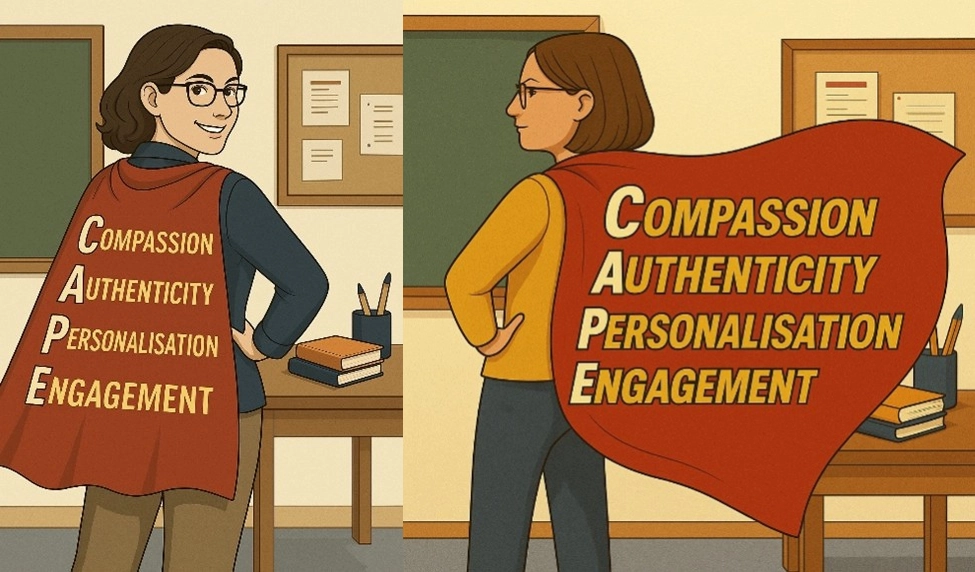
- Compassion. Staff spoke about the importance of creating emotionally safe environments where children feel understood. There was a strong sense that relationships begin with putting empathy into practice with the young people we work with.
- Authenticity. Staff were clear that relationships cannot be built without being genuine. Pupils and families need to feel that adults mean what they say and care about what they are doing. Trust develops over time through honest and consistent interactions.
- Personalisation. Relational practice was described as deeply individual. Staff emphasised the need to understand each child in their own context rather than relying on general approaches. Knowing a child well was seen as the foundation for everything else.
- Engagement. This involved being present, available and willing to connect, even when conversations are difficult. Staff spoke about the importance of open communication and of not avoiding challenging moments with families.
These ideas were brought together in what we describe as the CAPE framework. It is not intended as a fixed model, but as a helpful way of naming what many staff are already doing in practice.
How are relationships built in practice?
In terms of practice, there was a clear distinction between formal and informal approaches. Formal approaches included structured interventions such as emotion coaching and targeted support strategies. However, the informal interactions seemed to carry just as much weight. Staff talked about everyday moments. Greeting pupils, noticing small details, sharing a joke, asking about interests.
Alongside this, staff reflected on the personal qualities that support relational work. Five traits came through strongly. Being caring, honest, enthusiastic, encouraging and reliable. What stood out here was the sense that relationships are shaped as much by how adults show up as by the strategies they use. Staff spoke about being consistent and showing pupils that they matter. These are not fixed qualities. They can be developed through reflection and training.
What helps and what gets in the way?
Staff described relationship centred school cultures as a key enabler. When relationships are prioritised across the whole setting, it becomes easier for individuals to work in this way. Positive relationships between staff were also seen as important. When adults feel supported, they are better able to support pupils.
At the same time, there were clear challenges. Staff spoke about the difficulty of building meaningful relationships when their time with pupils is limited. Workload and staff turnover were also seen as barriers, making it harder to maintain consistency. There was also an interesting reflection on wider societal changes. Some staff felt that shifts in how people connect outside of school have made relationship building more complex within it. They felt that the increase in online communication may be impacting the way children and young people interact and making the formation of positive relationships more difficult. This is very topical at the moment with phone bans in school coming into effect recently in Australia. Are they leading the way in promoting positive relationships for young people?
How do pupils experience relational approaches?
Although this study focused on staff perspectives, participants offered thoughtful reflections on how pupils might experience relational practice. They spoke about pupils feeling accepted and understood. About the importance of not feeling anonymous in school. About relationships helping pupils to feel valued. There was also a strong sense that relational approaches can be empowering. Staff felt that clear boundaries, held within a trusting relationship, can help prepare pupils for life beyond school. In this sense, relational practice is not only about support, but also about development.
What does this mean for practice?
For me, one of the most useful aspects of this research is that it offers a shared language. Ideas such as CAPE and the relational traits provide a way of talking about practice that feels accessible and grounded. This has implications for how we work as educational psychologists. It gives us a clearer starting point for conversations with schools and supports a move towards more consistent understanding across staff teams. The study highlights the importance of whole school approaches. Relationships are not the responsibility of one role. They are shaped by everyone in the system, including teaching and non-teaching staff. There are also implications for staff development. Relational work is not simply about adopting new strategies. It involves reflection on personal practice and on how we relate to others. Creating space for this reflection is essential.
More broadly, the findings point to the importance of developing relational approaches with, rather than for, school communities. The insights in this study come directly from school staff experience, and this kind of co-constructed understanding is likely to be more meaningful and sustainable in practice. Finally, there are wider systemic questions. If relationships are central to pupil outcomes, then schools need the conditions to prioritise them. This includes time, stability and supportive leadership. The shift towards the terminology of ‘working relationally’ highlights the need for systems to support relational approaches rather than them being solely practiced on the individual level. As educational professionals we should be looking at systems to ensure they are conducive to building positive relationships and challenge those that are not.
Looking ahead
This study is only a starting point. It offers a snapshot of how a small group of staff understand and enact relational practice. There is much more to explore. In particular, there is a clear need to centre the voices of children and young people. Their perspectives are essential if we are to fully understand the impact of relational approaches. There is also value in exploring how relational practice is shaped by different cultural and contextual factors. What feels relational in one setting may not look the same in another. As educational psychologists, we are in a position to support schools to notice, value and strengthen relational practice.
And remember… put on your relational CAPE and CHEER on the young people you work with.
You can read the full research paper here: Full article: Working relationally in educational settings: exploring school staff perspectives on practice and their perceptions of children and young people’s experiences
Stay connected with news and updates!
Sign up to receive updates, resources, inspiring blogs and early access to our courses.
Don't worry, your information will not be shared.
